
Job sites evolve by the minute, yet marketing teams are not able to keep up. This is not an effort problem; it is a strategy problem. Ask any marketing head of a multi-site construction company what's posted at their newest job site right now, and you'll usually get a pause before an answer. That pause is the problem. When project managers handle their respective sites as they see fit, brand consistency grows into a bigger issue at the operational level. Additionally, effective brand control for construction companies requires a smart approach, which most companies cannot devise.
A brand control system for construction is a centralized platform that streamlines the process of approval, order, and delivery of marketing materials, signage, and branded products. The result is that project managers get exactly what they need, without the need to go off-brand. Additionally, it helps marketing teams ditch the manual fulfillment desk-style functioning.
This guide dives deeper into the causes of brand inconsistency at scale, the mistakes most firms make before fixing it, and what a real solution looks like. We will also discuss how to implement the right system without unnecessary disruptions or delays.
The Problem: Where Brand Inconsistency Actually Comes From
Most construction marketing teams don’t have the right infrastructure to ensure brand consistency. When dozens of active sites are sourcing materials independently, the drift cannot be avoided. This shows up in many ways, such as:
Different Ordering
Without a shared source of approved materials, every site begins its own brand interpretation. As a consequence, the signage starts to look slightly different, usage of logos varies, and messaging goes off-script despite following the same theme. Of course, none of this is intentional; it's just a series of things that happen when there’s no multi-site construction brand control.
Workload Displacement
Somewhere along the way, the marketing departments at different construction firms start sending emails asking for updated signage, approval on the latest logos, and alignment of branding elements. Every query steals time from actual strategic work. At larger firms where dozens of active sites are involved, the time wasted adds up pretty quickly.
Lack of Monitoring
Many job sites are remote or are not frequently visited by marketing leads. Since there’s no unified way to monitor what’s happening at what site, managing a brand becomes difficult. Without a dashboard, inventory, or other such system, leaders are left with no choice other than picking up the phone or driving to the site, which can take up a lot of time and energy.
The Effect: What Happens When Multi-Location Brand Consistency Isn’t Maintained
When the gaps in ordering, workload, and monitoring are left unaddressed, they create serious risks that can affect compliance, budget, and operations. This explains how important it is to focus on construction marketing materials management.
Safety Signage
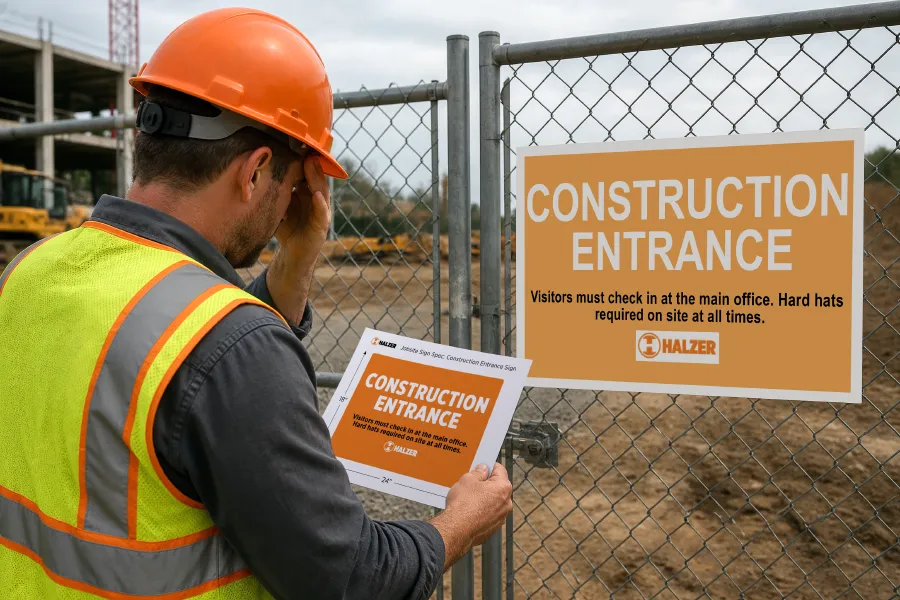
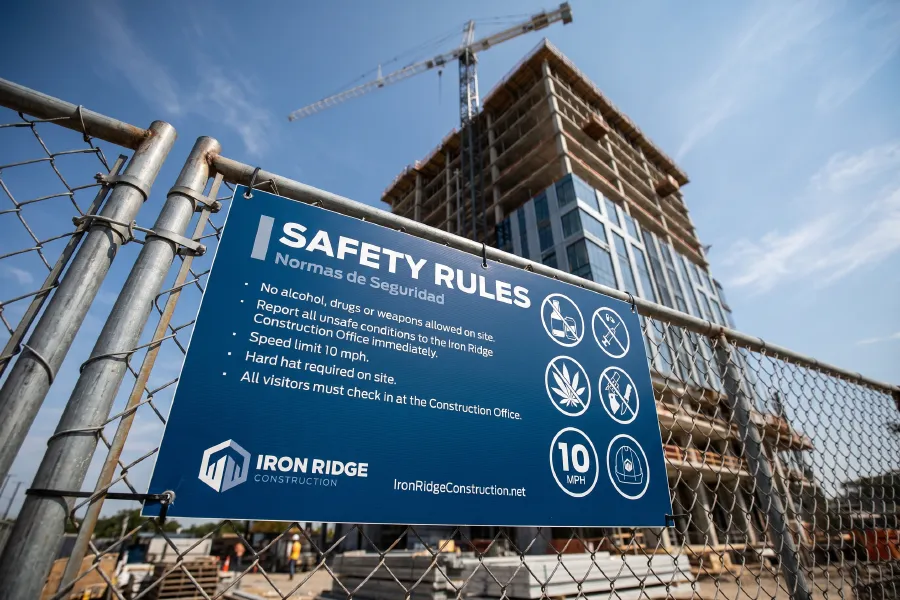
Required postings, compliance warnings, and site-specific safety materials are often sourced from whichever vendor is located closest to the site. Ideally, the sourcing should be done only from a vendor who matches the brand’s standards and regulatory requirements. Eventually, this branding inconsistency could lead to a serious construction brand compliance risk.
Inflated Costs
Fragmented vendor relationships also mean that the pricing is not negotiated consistently, and there’s no volume leverage either. So, firms end up paying more for materials with varying qualities. If a centralized program is in place, the materials for all the sites can be sourced from a single vendor, the prices can be drastically reduced for bulk ordering, and every site benefits from a lower cost due to extra negotiation.
New Site, New Scramble
When a standard system is not in place, every new project brings a new scramble. Someone has to spend time gathering documents, tracking down a vendor, and placing an order, only with the hope that it arrives correctly. This loop repeats indefinitely at every single site launch, which is not only inefficient but also frustrating. An established multi-site construction brand control eliminates this problem.
Top 5 Mistakes by Construction Firms Before Getting Their Brand Under Control
Before a centralized marketing portal for construction firms is devised and brought into action, there are many mistakes they make. Here are the top five:
1. Sourcing Signage Locally for Each Site
If you look at one job site, a project manager handling the signage locally feels efficient. There are no bottlenecks or the need to wait for corporate approval. Now, multiply that by fifty active sites, and what looked efficient will seem incoherent to you. Local vendors rarely have a detailed understanding of a brand’s standards. Execution also varies enough to make the fifty sites’ signage look like they belong to fifty different companies.
2. Equating a Shared Drive With a Portal
Branded materials management for construction companies requires a well-rounded portal or platform, not merely a shared Drive or Dropbox folder where a few templates and email drafts are stored. Such folders accumulate outdated files swiftly, and a project manager who is under deadline pressure is likely to grab whatever is in the folder rather than searching for the latest version.
3. Procuring Safety Signage Separately
Treating safety materials as a different category from branding materials and sourcing them through a different process just leads to more mismatches. Without a centralized system, different sites end up with different layouts, different working, and no standard way of knowing what is posted where. This matters more because safety signage compliance across job sites is not an option; it is a necessity.
4. Tracking the Wrong Success Metric
Plenty of teams at construction sites consider the job done once the materials have physically arrived. They barely pay attention to the actual question: did the correct materials, with the right specifications, and brand alignment, arrive at the site? Considering that “it got delivered” is the same as “it is right” is one of the biggest mistakes, and avoiding it adds further to the inconsistency problem.
5. Skipping the Onboarding Steps
In the absence of a single and up-to-date source of approval, every new project manager will only get an informal brief, an outdated email, or a folder link that is practically of no help to them. Consequently, every onboarding will become another point where the standards will decline. Such firms have to re-explain brand basics again and again, which is not efficient.
What Changes With a Centralized System

The difference between firms without a brand control system and those operating with a centralized system shows up in how much manual coordination their marketing teams are still doing.
Without a system, project managers request materials individually by sending an email, and the marketing team manually approves and fulfills each one. In this case, nobody has a clear record with details about the materials, vendors, and sites. Even worse, by the time off-brand signage is discovered (if at all), it has already been installed. The new project managers just receive an email and a shared link, and the brand standards need to be discussed from scratch every time. To avoid decentralized ordering brand inconsistency, having a proper system becomes crucial.
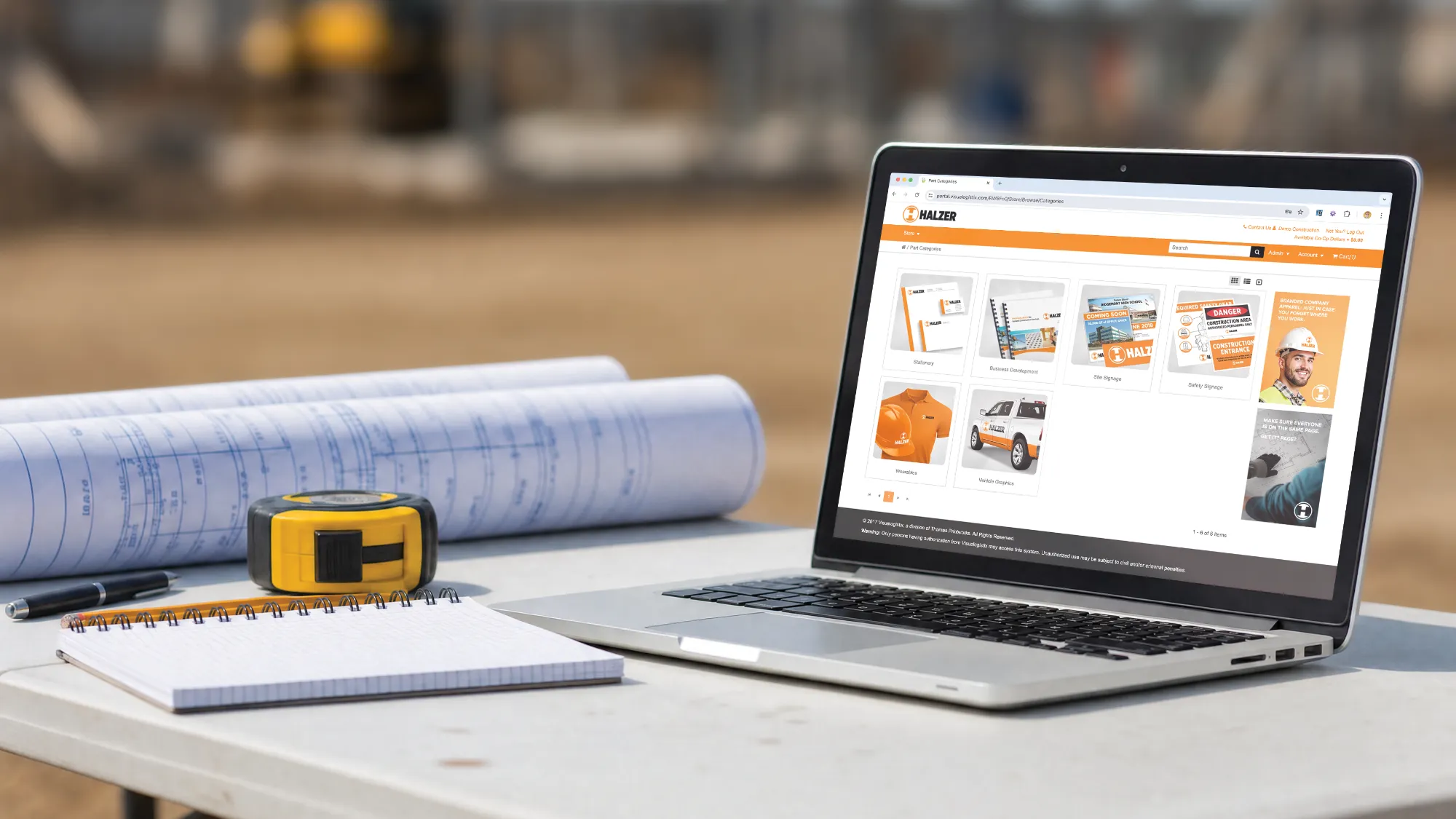
With a centralized system, project managers get round-the-clock access to a dedicated portal where all the pre-approved materials are documented. There’s no chance of an off-brand option being chosen, because nothing such is in the catalog. Standards are enforced automatically at checkout rather than being checked after the order is placed. Furthermore, marketing teams receive real-time updates regarding what has been ordered and where it is delivered.
The practical effect of a system for brand control for construction companies is that brand compliance stops depending on how attentive each of the individual marketing managers is and starts becoming a benchmark that the system itself upholds.
The Construction Marketing Supply Chain, Explained
When one thinks of “brand control”, it may sound like a governance function, involving rules, approvals, and sign-offs. However, for a multi-site construction company, brand control is something that needs to be paired with the right physical infrastructure. This will enable consistency in the production and delivery of materials. For a clearer understanding of this combination, it is best to view it as a marketing supply chain.
The construction marketing supply chain operates in three stages that are interconnected. These are:
Manage: Centralize Control
This is the governance layer, wherein a portal is formed, which project managers can use to place orders. The portal is smartly built, containing only materials that have already been approved. Access can also be specifically scoped, based on role, region, or site, so that a project manager at one location sees exactly what’s relevant to their site.
Every action that the user takes inside the portal is also logged (what was ordered, who placed the order, and for which site). So, what used to be invisible activity will now become something marketing leadership can actually audit.
Produce: Print, Kit, and Prepare
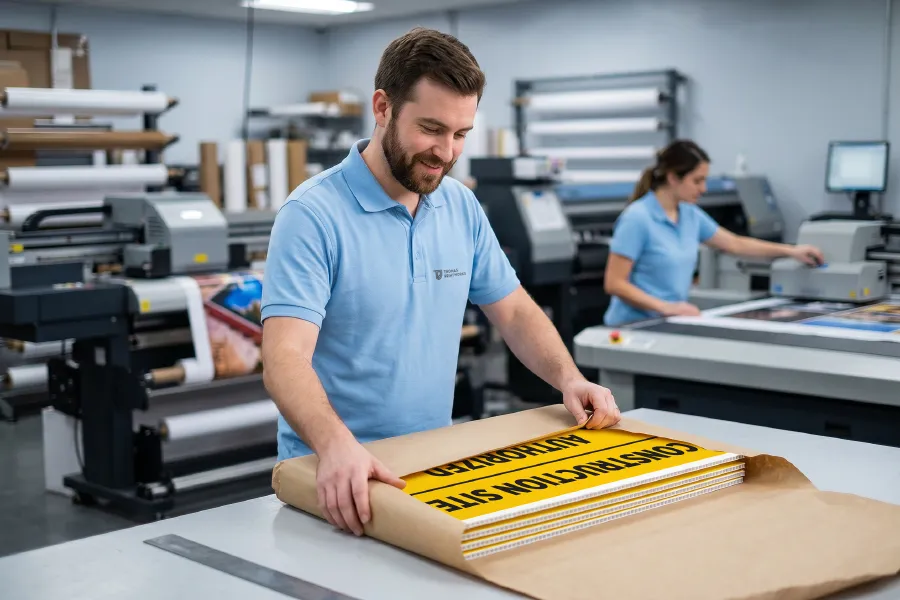
This refers to the stage where the materials are made. Produce covers a breadth of things, from job site signage and required safety postings to apparel and promotional products. Construction-specific document printing is also included, such as plan sets, spec books, and bid documents.
The ultimate goal of centralizing production isn't just convenience; it is to ensure that materials are produced through one controlled pipeline, which is important for consistency in quality and specification, something that materials sourced from multiple vendors cannot even come close to. This is the best way to eliminate construction brand chaos.
Fulfill: Direct to Every Site
The final part of the process is the delivery mechanism, which ensures that the materials are delivered directly to the job site that requested them, irrespective of which corner of the country the site is in. The best systems also ensure that tracking and delivery confirmation are provided along the way.
The “Fulfill” stage is the one that most brand management tools and construction companies skip. Most tools help a company manage its digital assets and approve templates. What they are not able to do is physically get materials to reach a remote job site, shifting the responsibility to a marketing coordinator, who definitely has better things to do.
Why Does This Distinction Matter?
There are hundreds of platforms out there marketed toward construction and multi-location brands. However, they only solve the “manage” part. They serve as a digital filing cabinet with permissions, which is useful, but not adequate. A company still needs to find a printer, coordinate shipping, and track deliveries on its own, which is time-consuming. A genuine construction marketing supply chain addresses construction signage and safety materials management, along with production and fulfillment. When a program operates largely on its own, it takes the strain away from the marketing teams at a firm.
Core Capabilities to Look Out For Before Making a Choice
Not every brand management platform is built for the particular demands of the construction sector. Distributed sites, physical materials, safety compliance, and frequent project launches – everything needs to be taken into consideration. If things don’t work out sufficiently well with a platform, the construction marketing team fulfillment desk will still be busy, which is not the goal. So, understanding the core capabilities worth evaluating specifically in this use case is imperative. These include:
Pre-Approved Materials Library
The platform should feature an extensive library with all the pre-approved materials required. However, presenting the entire searchable archive to every individual is not a good idea; too much material will only confuse them. Instead, project managers should only be able to see the materials that have cleared brand approval and are relevant to their site.
Role-Based Access
While multi-location brand consistency is an operational goal, each site, region, and team may need a different subset of materials at a point. To make ordering simple for the people doing it and prevent confusion, it is essential that role-based or location-based access is provided through the platform. Construction firms need to understand that overcomplicating things is not needed to enhance efficiency.
Controlled Local Customization
Site-specific information, such as the address, project name, and phone number, needs to be fed into the system. While these particulars can be edited, the user should not be able to touch the locked brand elements like logo placement, color, or typography. Systems that allow these distinctions promote customization while keeping the core brand elements constant, which is the sign of a smart platform.
Real-Time Ordering and Inventory Visibility
Whether it is jobsite signage management or anything else, marketing leadership should be able to see which sites have ordered what and what’s in stock or in production at any given moment. This is what aligns the fulfillment process with the operational intelligence and streamlines the entire thing. Leadership can also make decisions based on these real-time updates.
Audit-Ready Reporting
Every small and big thing, order, customization, shipment, etc., should be traceable right from the moment the action is taken. This is essential for internal accountability in general and for demonstrating compliance in regulated or safety-sensitive contexts. However, just having the right reports is not enough; the firm should also be able to observe important metrics in them and check for shifting trends.
Built-In Handling of Safety Materials
Construction signage and safety materials management should not be seen as separate from other processes. If the procurement track changes, it brings along a new set of vendor relationships and inconsistency risks. If the handling of safety materials belongs inside the same controlled system as every other branded material, these materials will be produced to the same standard every time.
Use Cases: Where This Actually Works
Here’s a detailed list of the use cases where this system is applicable:
A New Job Site Needs a Full Brand Kit Immediately
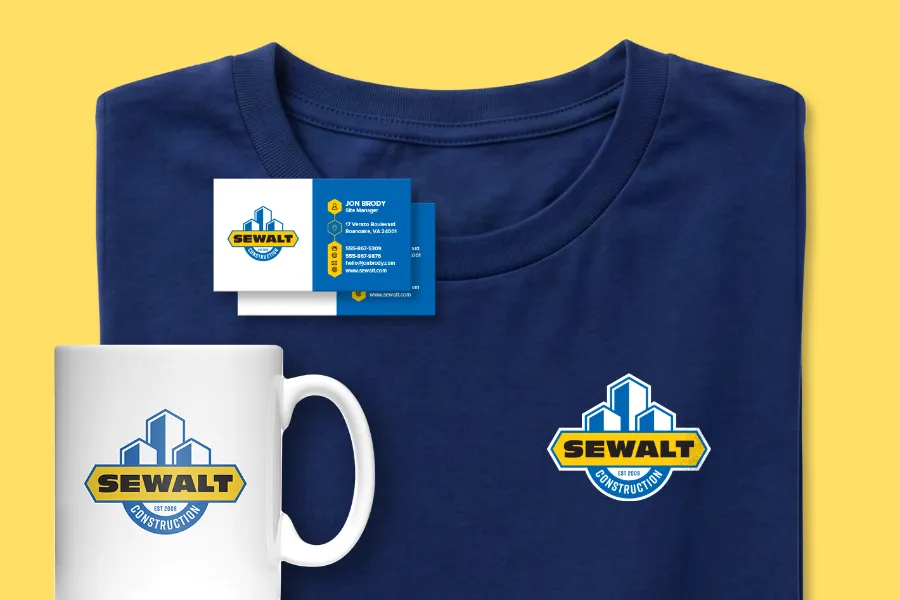
Back in the day, onboarding a new site meant emailing marketing for signage, safety materials, and branded items. They didn’t send this right away; there was a significant amount of waiting involved. Meanwhile, someone tried tracking down a vendor, usually one nearby. Now, the picture has changed, making construction marketing materials management easier.
With a centralized system, a project manager simply logs into the portal, selects a pre-approved kit for their site, and materials ship directly to their site. No need to email the marketing department, no approval bottlenecks, and no delays in the process.
Safety Signage Should Be Correct and Consistent
The centralized marketing portal for construction has a locked specification, which means the safety materials will be produced with the same attributes every time. Additionally, just like everything else, safety signage will also be distributed through a controlled pipeline.
When the standards are set and locked, there’s no room for a local print shop to substitute the material with something slightly different. If a health, safety, and environment manager or officer is involved, they also get a usable audit trail that highlights what was ordered, produced, and delivered to each site.
A Large-Scale Rollout of Rebranding or New Initiatives
Suppose a company is getting rebranded, implementing new safety initiatives, or making any other significant change; every person on every site should be aware of it. Now, if a centralized system is not present, this kind of rollout will be carried out through an email chain. There’s no reliable way to confirm whether every site received and implemented the update.
With a platform that enables brand control for construction companies, an update gets pushed to the portal once and applies everywhere simultaneously. There is no scope for missed sites or approvals being stuck in someone’s inbox for weeks, which means no inconsistencies will exist.
On-Demand Availability of Construction Documents
While plan sets, spec books, bid documents, and as-built drawings are not considered marketing materials in a traditional sense, they’re high-volume, recurring print needs for any active construction firm that aims for perfection and excellence.
When these construction documents are routed through the same managed system that handles the branded materials, it is possible to ensure consistent quality and turnaround without the need for adding a new vendor relationship. For a busy and thriving firm, managing a second vendor relationship is tedious.
The Implementation: What the Clear Picture Looks Like
While the entire idea of having a centralized system for the branded materials management for construction companies sounds amazing, most firms are reluctant to embrace it. This is primarily because of the assumption that implementation will be slow, disruptive, and require significant internal resourcing to be successful. However, that’s not true. Typically, most construction marketing supply chain programs follow a defined rollout process that takes approximately six to eight weeks from kickoff to launch.
Here’s a clearer view of the process and timeline:
Weeks 1 and 2: Defining the Scope
The first two weeks are spent understanding the scope of the project, which includes:
- Finalizing the stages or categories of materials that the system will cover
- Setting up the actual portal workspace
- Mapping the system to how the company’s construction process already works
- Importing the list of currently active project sites
Weeks 3 and 4: System Integration
Weeks three and four focus on connecting the system to the rest of the company’s infrastructure, which encompasses the following steps:
- Building any required integrations with existing tools (such as single sign-on or a CRM)
- Finalizing which materials will be stored in the approved library
- Configuring access tiers so that the right people are able to see the right things
In addition to integrating the system for construction brand compliance, the ordering flow is also tested end-to-end. This confirms that the new portal is 100% ready before anyone outside the rollout team touches it.
Weeks 5 and 6: Training and Launch
The next two weeks are all about getting people to use it. Here’s what this phase looks like:
- Project managers are required to attend onboarding sessions
- The marketing managers walk through their reporting dashboard
- The system goes live with real materials, not a test environment.
The first round of the actual ordering also happens during this window.
Weeks 7 and 8: Review and Adjustment
The seventh and eighth weeks are dedicated to reviews and adjustments to the branded materials management for construction companies system. This involves:
- Checking how the program is actually being used
- Tightening access tiers or the materials library if gaps are revealed in the early usage stages
- Documenting the procedure so that it can be repeated the next time a new site needs to be onboarded
Why Construction Firms Choose Visualogistix by Thomas Printworks
Visualogistix, built by Thomas Printworks, is one of the leading examples of a construction marketing supply chain that handles all three stages of the process as a single managed program. So, companies don’t need to do the hard work associated with managing a portal, a printer, and a fulfillment process on their own.
What makes Visualogistix unique is that every approved material, be it signage, safety postings, apparel, branded products, or construction documents, is produced in-house across eight facilities nationwide. Then, these materials are shipped directly to the job site from which the order was received. Tracking and delivery confirmation are also built into the process, and there’s no second vendor for companies to coordinate with. This is the best part, because no handoffs mean there is no space for things to slip.
Inside the portal, the brand guidelines are also locked. So, project managers can only place orders from a catalog that contains pre-approved materials. Of course, there’s the permission to edit local details, but this flexibility doesn’t shatter the benchmarks set by the brand, meaning multi-location brand consistency is ensured.
Due to its amazing features, the initiative is backed by a rating of 4.9 stars across more than 7,500 reviews. Construction clients primarily prefer Visualogistix by Thomas Printworks because of its consistent quality and on-time delivery.
Frequently Asked Questions
How do you maintain multi-location brand consistency across job sites while avoiding bottlenecking every order through the marketing team?
The brand guidelines are set once during the implementation, and details are provided regarding which materials are approved and which design elements are locked. After that, the project managers can directly order from the system, with no need for the marketing team to review or approve each request. This is an effective way to maintain brand consistency without bottlenecks.
What kind of materials can be managed through a construction marketing materials management system?
Job site signage, safety postings, branded apparel, promotional products, and construction documents (like plan sets, specification books, and drawings) can be run through the dedicated system. This ensures consistency and construction brand compliance, which is very important.
Is it possible for project managers to customize materials without violating the brand standards?
Yes, project managers can customize materials, but within limits. Site-specific fields, such as address, project name, or phone number, can be edited. However, the brand elements like logo placement, color, and typography are locked, ensuring that customization happens inside defined boundaries so that brand standards are not violated.
How long does it take to set up the multi-site construction brand control system for a company with 200+ active locations?
Usually, the implementation of a system for construction signage and safety materials management takes six to eight weeks. This is usually independent of the company size, because the work majorly involves defining the scope, system integration, launch, onboarding, and final adjustments. So, it is not a function of how many individual sites of the construction company are active.
How is a construction marketing supply chain different from just setting up an online print ordering store?
When a company works with an online print store, it still has to take up the responsibility of managing logistics, such as chasing fulfillment, tracking shipments, and coordinating deliveries to specific sites. On the contrary, a construction marketing supply chain handles everything, the portal, production, and site-wise delivery as a part of one connected program. Thus, nobody from the marketing team needs to spend time manually managing these steps.
What happens to brand standards when a company rolls out a new project site mid-quarter?
The new site is simply added to the active site list on the centralized marketing portal for construction, and the project manager is given role-based access. There’s no need to start the process from scratch, because the pre-approved materials library on the system already reflects the current standards.
Does this centralized marketing portal for construction work only for large construction firms, or does it work for smaller multi-site operations too?
The core problem this portal aims to solve is the inconsistency that comes from sites sourcing materials independently without a shared system. This construction brand chaos can show up in both kinds of companies with hundreds of active locations and those with a handful of sites, just the scale of the problem varies. So, it is apparent that even smaller multi-site operations can benefit from such a centralized portal.
What level of reporting can marketing leadership expect to see on the portal?
Through this portal, leadership can see what has been ordered by which site and project manager, when the shipment leaves the facility, and when it is delivered to the specific site. Additionally, they get to see usage patterns over time. The result is that what used to be invisible activity has turned into something that can actually improve budget and vendor-related decisions.
What happens to existing inventory or pre-printed materials when a company switches to a managed system?
When a company switches to a standardized construction marketing materials management system, the existing inventory or pre-printed materials are addressed during the implementation phase. These can typically be used until the stocks last, and the new order can be routed through the portal going forward. All in all, the transition doesn’t require you to discard any materials that are still usable.
Who typically owns the system internally once it is live: marketing, project management, or IT?
In most rollouts, the roles are distributed; the marketing team owns the approved materials library and brand standards, the IT team is involved mainly in setup and integrations, and project managers self-order directly from the portal. Day-to-day ordering for jobsite signage management doesn’t require ongoing involvement from either of the teams.
Closing Thoughts
Brand inconsistency exists across many construction job sites. However, looking at it as a failure of an individual project manager or marketing coordinator is wrong. When you ask people to manage a distributed brand with email, shared drives, and good intentions, construction brand chaos is a predictable outcome. The firms that solve this are simply replacing a manual and tedious process with a system, one that makes the right choice the only available choice, leaving no room for errors.
If your team is still fielding individual material requests, discovering off-brand signage after it is already installed, or is unable to say with confidence what’s posted at your active sites, it is a sign that the system underneath your operations needs to change. This is where a good construction marketing materials management platform can prove to be helpful.
If you are also a construction brand that wants to stop coordinating and start controlling, you must see Visualogistix by Thomas Printworks in action and understand how it can take your construction marketing materials management to the next level. Schedule your demo now!